
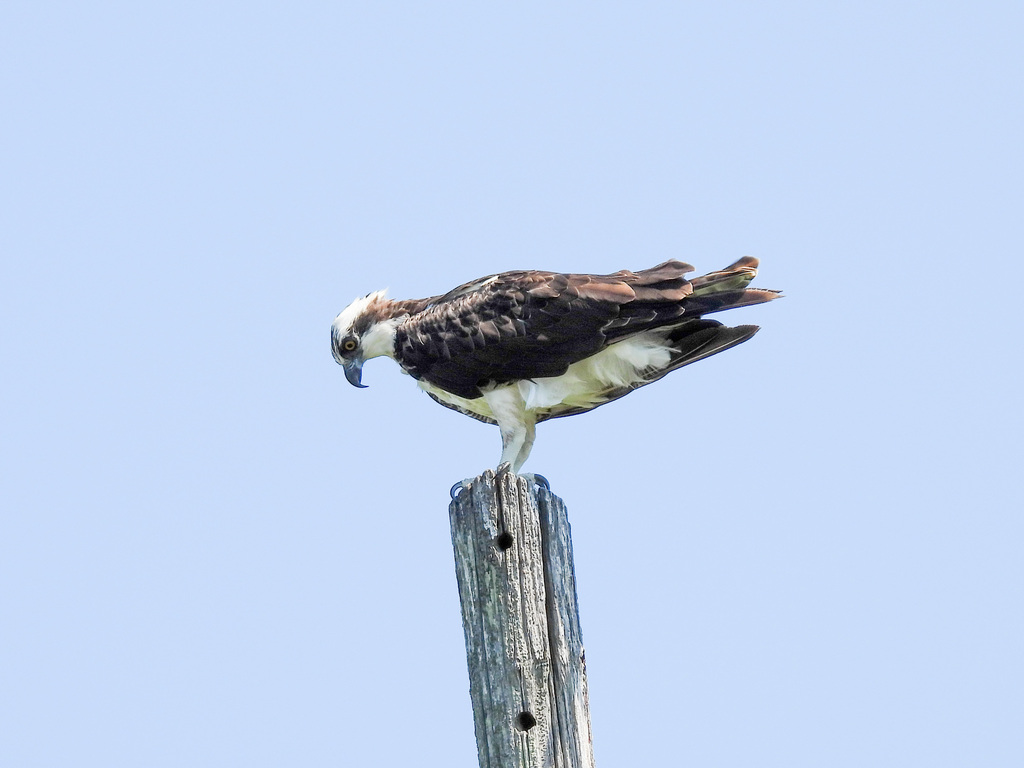
A large, long-winged species of hawk found along seacoasts and large interior waterways. Ospreys are about 24 in. long with a 5 ft. wingspan. They have a brown back, white belly, a white head with a dark line through the eye and on the side of the face, and a distinctive bend at the “wrist” of the wing. Ospreys can spot fish from heights of 30 to 100 ft. After hovering, they plunge feet first into the water, seizing the fish in their long, curved talons. The osprey population declined drastically during the mid 1900s due to the pesticides being used, but they are now recovering.
American Osprey
Pandion haliaetus carolinensis
Least Concern
Quick Facts
Kingdom:
Animalia
Abundance:
Common
Habitat:
Forest, Wetland
Active Seasons:
Spring, Summer, Fall
Activity:
Diurnal (Active during day)
Lifespan:
Up to 25 years
Overview
The osprey is piscivorous, with fish making up 99% of its diet.
Diurnal (Active during day)
Classification
Kingdom:
Animalia
→
Phylum:
Chordata
→
Class:
Aves
→
Order:
Accipitriformes
→
Family:
Pandionidae
→
Genus:
Pandion
→
Species:
Pandion haliaetus
Scientific Name
Pandion haliaetus carolinensis
Characteristics
Breeding Season
Breeding begins between December and March in non-migratory populations. In migratory populations, breeding begins in April or May.
Migration Pattern
Migrates south for the winter
Lifespan
Up to 25 years
Behavior & Ecology
Behavior
Ospreys have a vision that is well adapted to detecting underwater objects from the air. Prey is first sighted when the osprey is 33–131 ft above the water, after which the bird hovers momentarily and then plunges feet first into the water. They catch fish by diving into a body of water, oftentimes completely submerging their entire bodies. Courtship displays include pair circling high together; male may fly high and then dive repeatedly in vicinity of nest site, often carrying a fish or stick.
Active Seasons
Spring
Summer
Fall
Activity Pattern
Diurnal (Active during day)
Habitat & Distribution
Habitat Types
Geographic Distribution
Most Ospreys that breed in North America migrate to Central and South America for the winter, with migration routes following broad swaths of the eastern, interior, and western U.S. A few Ospreys overwinter in the southernmost United States, including parts of Florida and California.
Local Abundance
Common
Conservation
Conservation Status
Least Concern
This species is widespread and abundant. No immediate threat to survival.
How You Can Help
- Report sightings to contribute to population monitoring
- Support habitat conservation efforts
- Follow guidelines when observing wildlife
Contribute Your Observations
Have you spotted this species? Your observations help us track populations and understand behavior patterns.
Submit an Observation