
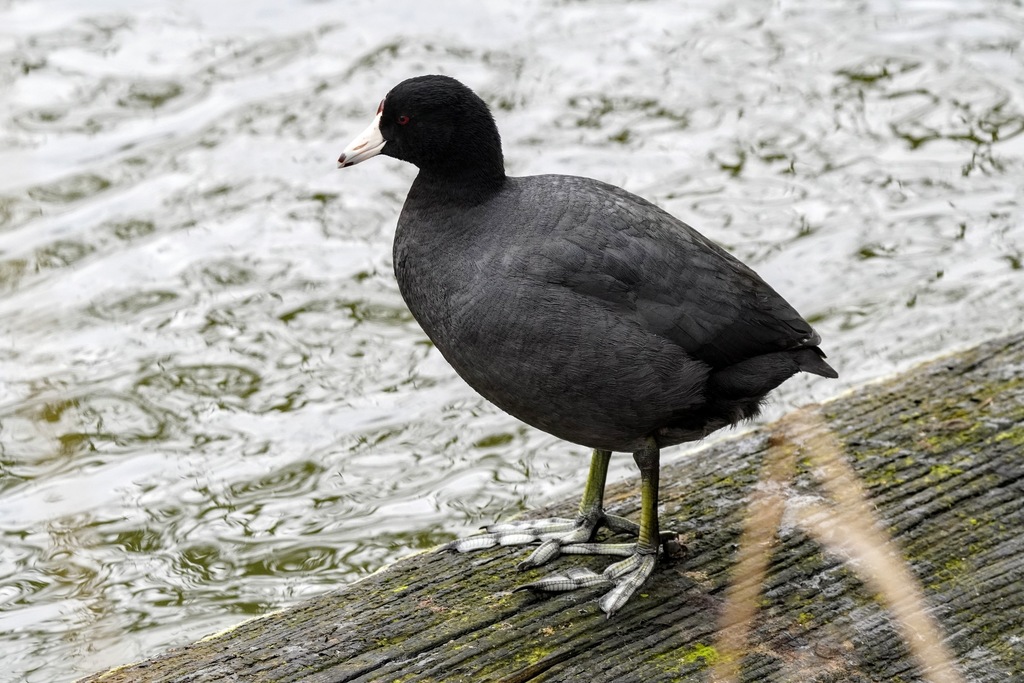
A gray, duck-like bird with a dark head and neck, yellow legs, and a short white bill that has a red spot at the base between the eyes. The Coot can dive for food or forage on the land. They are excellent swimmers and divers, and are often seen feeding with ducks. Coots are heavy birds that must pedal across the water with their feet before becoming airborne.
American Coot
Fulica americana
Least Concern
Quick Facts
Kingdom:
Animalia
Abundance:
Abundant
Habitat:
Wetland
Activity:
Diurnal (Active during day)
Lifespan:
9 years on average
Overview
Omnivorous, feeding on plant material as well as insects, tadpoles, fish, worms, snails, crayfish, and prawns
Diurnal (Active during day)
Classification
Kingdom:
Animalia
→
Phylum:
Chordata
→
Class:
Aves
→
Order:
Gruiformes
→
Family:
Rallidae
→
Genus:
Fulica
→
Species:
Fulica americana
Scientific Name
Fulica americana
Characteristics
Breeding Season
May-June
Migration Pattern
During the summer, these birds are found in freshwater lakes and ponds of the northern United States and southern Canada. During winter, they head to the southern portion of the United States and are found from California to Florida.
Lifespan
9 years on average
Behavior & Ecology
Behavior
Fulica americana is a social bird species that lives in flocks. They can make a wide variety of noises, from grunting to clucking, as a means of communication, between each other and to threatening predators. There are two times a coot will splash: during mating season to attract attention and to discourage predators. Coots take a running start across the water to become airborne.
Ecological Role
American Coots influence populations of aquatic invertebrates and plants and serve as a prey base for predators in their habitats.
Activity Pattern
Diurnal (Active during day)
Habitat & Distribution
Habitat Types
Geographic Distribution
Fulica americana lives mostly within the boundaries of the contiguous United States, but individuals have been found as far away as Alaska and South America
Local Abundance
Abundant
Conservation
Conservation Status
Least Concern
This species is widespread and abundant. No immediate threat to survival.
How You Can Help
- Report sightings to contribute to population monitoring
- Support habitat conservation efforts
- Follow guidelines when observing wildlife
Contribute Your Observations
Have you spotted this species? Your observations help us track populations and understand behavior patterns.
Submit an ObservationGallery
Learn more
More about this species on All About Birds ↗ (opens in a new tab)