
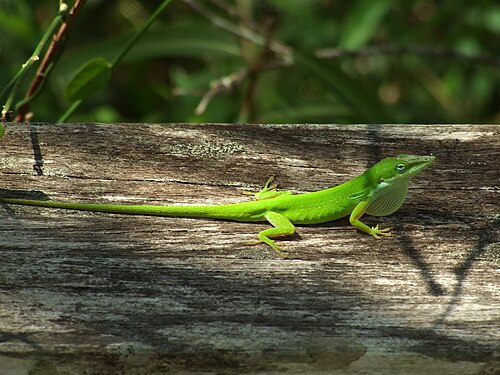
Green Anole

Green Anole

Anolis carolinensis

Least Concern

Quick Facts

Kingdom: Animalia
Abundance: Common
Habitat: Urban
Active Seasons: Spring, Summer, Fall
Activity: Diurnal (Active during day)
Lifespan: 2 - 8 years

Small lizard often bright green but can turn brown; males have a prominent pink/red dewlap; adhesive toe pads for climbing. Common on shrubs/trees, fences, and buildings across the Southeast.

Diet

Insects and other small invertebrates.

Activity Pattern

Diurnal (Active during day)
Kingdom: Animalia
β†’
Phylum: Chordata
β†’
Class: Reptilia
β†’
Order: Squamata
β†’
Family: Dactyloidae
β†’
Genus: Anolis
β†’
Species: A. carolinensis

Scientific Name

Anolis carolinensis
Breeding Season
April - August
Nesting Season
Eggs laid throughout breeding season; hatching commonly late May - early October (eggs incubate ~5–7 weeks)
Migration Pattern
No migration
Lifespan
2 - 8 years

Tracks or Signs

Visual sightings on walls/vegetation; males displaying dewlap.

Behavior

Territorial displays by males; frequent head-bobbing and dewlap extension.

Ecological Role

Insect predator in yards/forest edges.

Active Seasons

Spring Summer Fall

Activity Pattern

Diurnal (Active during day)

Habitat Types

Urban

Geographic Distribution

Mainly the subtropical southeastern U.S.; widespread across much of the Atlantic/Gulf coastal plains including Georgia (except higher Blue Ridge areas noted).

Local Abundance

Common

Conservation Status

Least Concern

This species is widespread and abundant. No immediate threat to survival.

Threats & Impacts

Habitat change and competition with introduced anoles in some areas.

How You Can Help

  • Report sightings to contribute to population monitoring
  • Support habitat conservation efforts
  • Follow guidelines when observing wildlife

Additional Notes

Color change is influenced by stress/temperature and other factors; not true camouflage β€œchameleon” mechanics.

Contribute Your Observations

Have you spotted this species? Your observations help us track populations and understand behavior patterns.

Submit an Observation