
Lifespan:7 years on average in the wild; the oldest recorded individual lived 26 years and 11 months
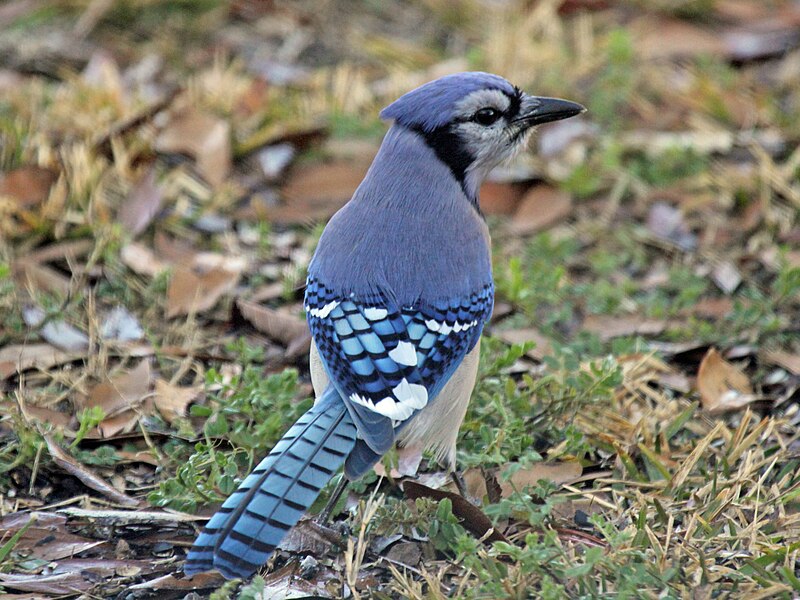
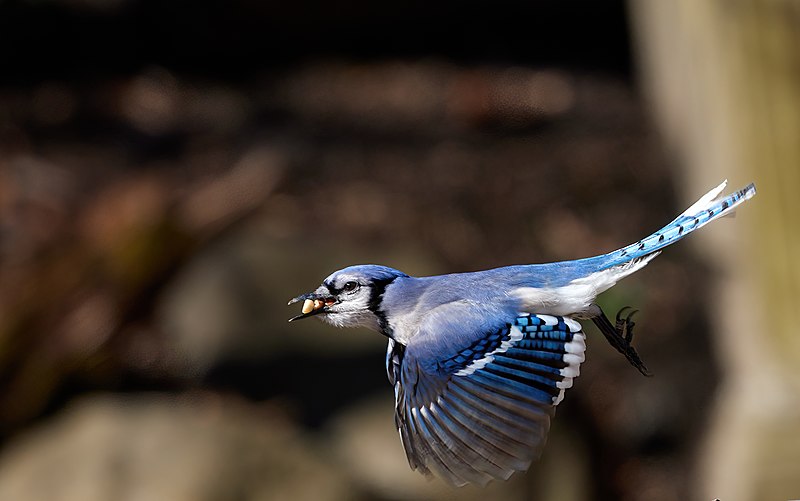
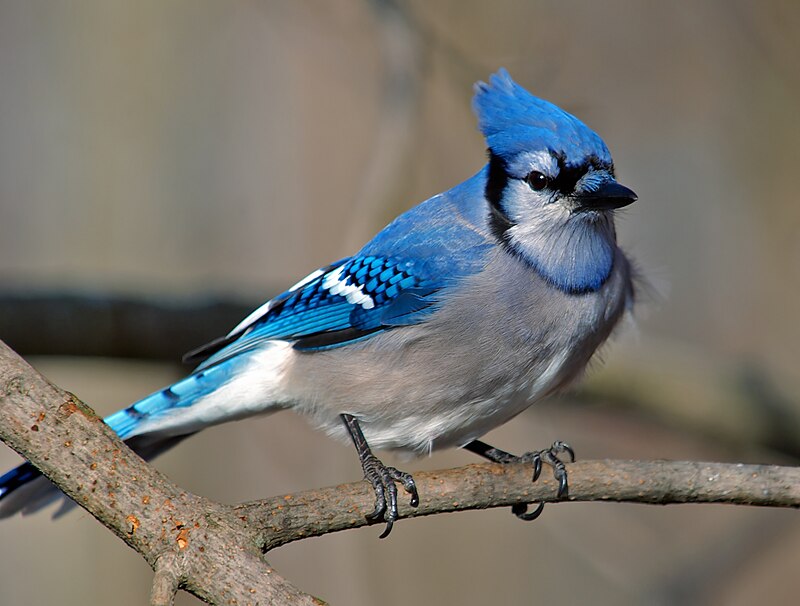
The Blue Jay is a large, striking songbird measuring 25 to 30 cm in length with a wingspan of 34 to 43 cm and a weight of 70 to 100 grams. Its plumage is predominantly brilliant blue above with a white chest and underparts, accented by a prominent blue crest, a black U-shaped collar around the neck, and black borders behind the crest. The wings and tail display bold blue, black, and white barring patterns. The blue coloration is not produced by pigment but by light refraction through specialized cells in the feathers; the underlying pigment is actually melanin-based brown.
Diet
Omnivorous with up to 75% of the annual diet consisting of plant material, especially acorns, beechnuts, hickory nuts, and other hard mast. They also eat corn, grain, sunflower seeds, berries, and various fruits. The animal portion of the diet includes beetles, caterpillars, grasshoppers, and other insects, along with occasional snails, bird eggs, nestlings, and small vertebrates such as frogs and mice. Blue Jays are well known for caching acorns and other nuts, burying thousands each fall for later retrieval.
Activity Pattern
Diurnal (Active during day)
Kingdom:Animalia
→
Phylum:Chordata
→
Class:Aves
→
Order:Passeriformes
→
Family:Corvidae
→
Genus:Cyanocitta
→
Species:C. cristata
Scientific Name
Cyanocitta cristata
Breeding Season
Mid-March through July, peaking in mid-April to May
Nesting Season
April through July; both sexes build a cup-shaped nest of twigs, bark strips, and moss in the crotch or outer branches of a tree, typically 10 to 25 feet above ground. The female incubates 3 to 6 eggs for 16 to 18 days.
Migration Pattern
Partially migratory; most individuals are year-round residents, but a small percentage (less than 20%) migrate south in fall and north in spring. Migration patterns are irregular and unpredictable, with individual birds migrating one year and remaining resident the next.
Lifespan
7 years on average in the wild; the oldest recorded individual lived 26 years and 11 months
Behavior
Blue Jays are bold, intelligent, and highly vocal members of the corvid family. Their raucous "jay! jay!" calls are among the most recognizable sounds in eastern forests, and they are skilled vocal mimics, frequently imitating the screams of Red-shouldered Hawks. They form monogamous pair bonds that often last for life, with both parents participating in nest construction, territory defense, and chick rearing. Blue Jays are cooperative and social, sometimes mobbing predators such as owls and hawks. They fly at moderate speeds of 32 to 40 km/h and are the only New World jay that undertakes regular seasonal migration, though the behavior is erratic and poorly understood.
Ecological Role
Blue Jays play a crucial role as seed dispersers, particularly for oaks. Their habit of caching thousands of acorns each fall and failing to retrieve many of them makes them one of the most important agents of oak forest regeneration and expansion. They also serve as a predator alert system for other birds, as their loud alarm calls warn the forest community of approaching hawks, cats, and other threats. As omnivores, they help regulate insect populations during the breeding season when protein demands are highest.
Active Seasons
Spring
Summer
Fall
Winter
Activity Pattern
Diurnal (Active during day)
Habitat Types
Forest
Urban
Geographic Distribution
The Blue Jay is native to eastern North America, ranging from southern Canada through the eastern and central United States. It is found year-round throughout the southeastern US, from Virginia to Florida and west to Texas. In the River Island Conservancy area near Augusta, GA, Blue Jays are common year-round residents found in deciduous and mixed forests, suburban neighborhoods, parks, and wooded edges along the Savannah River corridor. They are conspicuous and vocal members of the local bird community, frequently visiting backyard feeders and oak groves where they gather acorns.
Elevation Range
0-5000 ft
Local Abundance
Common
Conservation Status
Least Concern
This species is widespread and abundant. No immediate threat to survival.
Threats & Impacts
Blue Jay populations have experienced a cumulative decline of about 27% between 1966 and 2019 according to the North American Breeding Bird Survey, though they remain abundant. Threats include habitat loss from development, collisions with windows and vehicles, predation by domestic cats, and West Nile virus, which has caused significant mortality in corvid populations since its arrival in North America in 1999.
How You Can Help
Report sightings to contribute to population monitoring
Support habitat conservation efforts
Follow guidelines when observing wildlife
No field notes or observations available for this species.
Contribute Your Observations
Have you spotted this species? Your observations help us track populations and understand behavior patterns.