
Lifespan:Up to 13 years and 8 months in the wild, though typical lifespan is considerably shorter
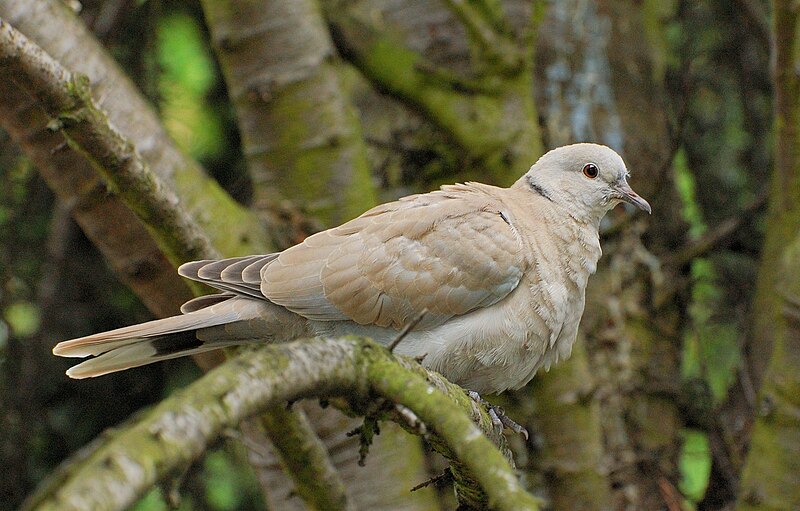
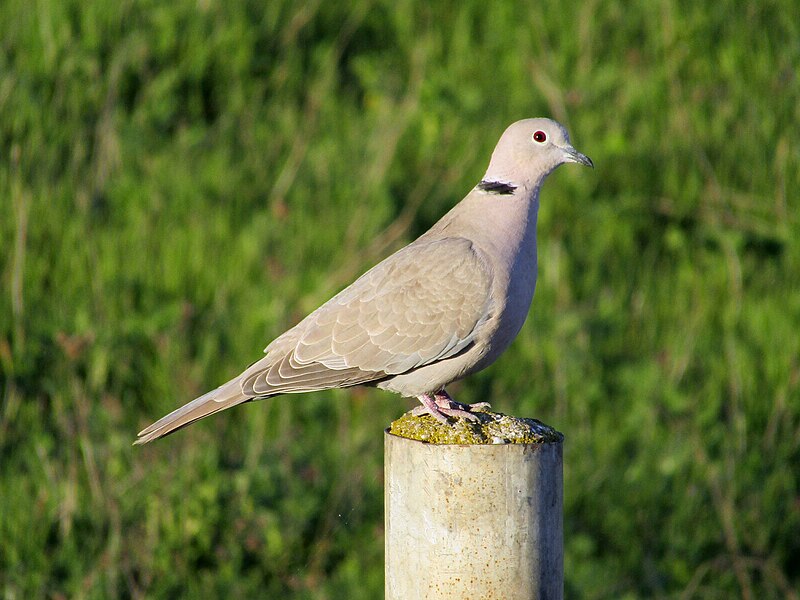
The Eurasian Collared-Dove is a medium-sized dove approximately 32 cm in length with a chunky body and long tail. Its plumage is a soft chalky gray-buff with a pinkish tinge on the breast, and it features a distinctive thin black crescent or collar on the back of its neck bordered by white. The eyes are dark reddish-brown surrounded by a narrow white eye ring, the bill is slender and black, and the legs and feet are pinkish-gray. In flight, the tail shows a broad white terminal band on the underside contrasting with dark gray bases.
Diet
Primarily granivorous, feeding on seeds and cereal grains including millet, sunflower, wheat, milo, and corn. Also consumes bread and other human food scraps in suburban settings, as well as berries and small invertebrates occasionally. Frequently visits bird feeders and forages on the ground around agricultural areas where grain has spilled.
Activity Pattern
Diurnal (Active during day)
Kingdom:Animalia
โ
Phylum:Chordata
โ
Class:Aves
โ
Order:Columbiformes
โ
Family:Columbidae
โ
Genus:Streptopelia
โ
Species:S. decaocto
Scientific Name
Streptopelia decaocto
Breeding Season
Year-round in mild climates; primarily February through November in the southeastern US
Nesting Season
Can nest in any month with adequate food; typically produces 3 to 4 broods per year, sometimes up to 6. Lays 2 white eggs per clutch with 14 to 18 day incubation.
Migration Pattern
Non-migratory; a permanent resident throughout its established range
Lifespan
Up to 13 years and 8 months in the wild, though typical lifespan is considerably shorter
Behavior
Eurasian Collared-Doves are not wary of humans and are commonly found feeding close to populated areas. They are highly social, forming large flocks in winter around abundant food sources. They are one of very few bird species that can drink with their heads down, submerging their bills and sucking up water as if through a straw. Their song is a repetitive three-syllable cooing, 'koo-KOO-kook,' often heard from rooftops and power lines. They build flimsy stick nests in trees, often near buildings.
Ecological Role
As an invasive species in North America, the Eurasian Collared-Dove occupies an ecological niche that may overlap with native species such as the Mourning Dove. Its rapid population expansion raises concerns about competition for food and nesting resources with native dove species. It serves as prey for raptors such as Cooper's Hawks and contributes to seed dispersal. Its role in potential disease transmission to native bird species is an area of ongoing study.
Active Seasons
Spring
Summer
Fall
Winter
Activity Pattern
Diurnal (Active during day)
Habitat Types
Urban
Grassland
Forest
Geographic Distribution
Originally native to Europe, Asia, and northern Africa, the Eurasian Collared-Dove was introduced to the Bahamas in 1974 and rapidly colonized the southeastern United States beginning in the 1980s from Florida. It has since spread across nearly the entire continental US. In the Augusta, GA area and the River Island Conservancy region, Eurasian Collared-Doves are now common year-round residents found in suburban neighborhoods, agricultural areas, and around bird feeders and grain storage facilities throughout the Central Savannah River Area.
Elevation Range
0-5000 ft
Local Abundance
Common
Conservation Status
Least Concern
This species is widespread and abundant. No immediate threat to survival.
Threats & Impacts
As an introduced and rapidly expanding species, the Eurasian Collared-Dove faces few threats in North America. Predation by raptors and feral cats accounts for most mortality. The species itself poses a potential threat to native dove populations through competition and possible disease transmission, including the protozoan parasite Trichomonas gallinae. It is not protected under the Migratory Bird Treaty Act and is classified as a game bird in many southeastern states.
How You Can Help
Report sightings to contribute to population monitoring
Support habitat conservation efforts
Follow guidelines when observing wildlife
Additional Notes
Invasive species in North America. Introduced to the Bahamas in 1974 and spread to mainland Florida by the early 1980s. Population has grown over 13% per year according to the North American Breeding Bird Survey.
Contribute Your Observations
Have you spotted this species? Your observations help us track populations and understand behavior patterns.