
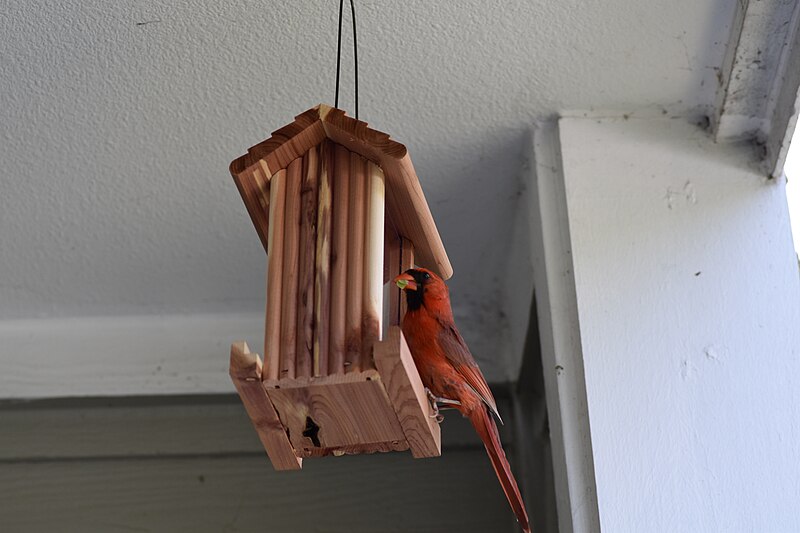
Northern Cardinal

Northern Cardinal

Cardinalis cardinalis

Least Concern

Quick Facts

Kingdom: Animalia
Abundance: Common
Habitat: Forest, Grassland, Urban
Active Seasons: Spring, Summer, Fall, Winter
Activity: Diurnal (Active during day)
Lifespan: Average 3 years in the wild, though individuals have been recorded living up to 15 years and 9 months

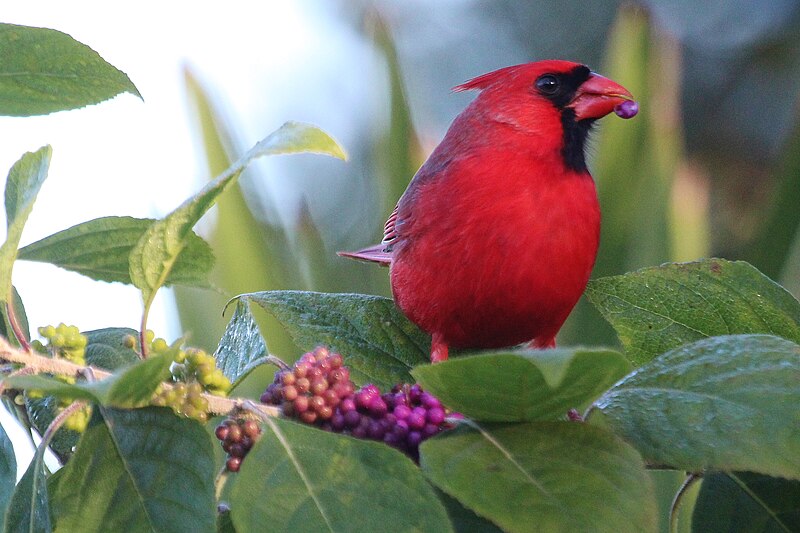
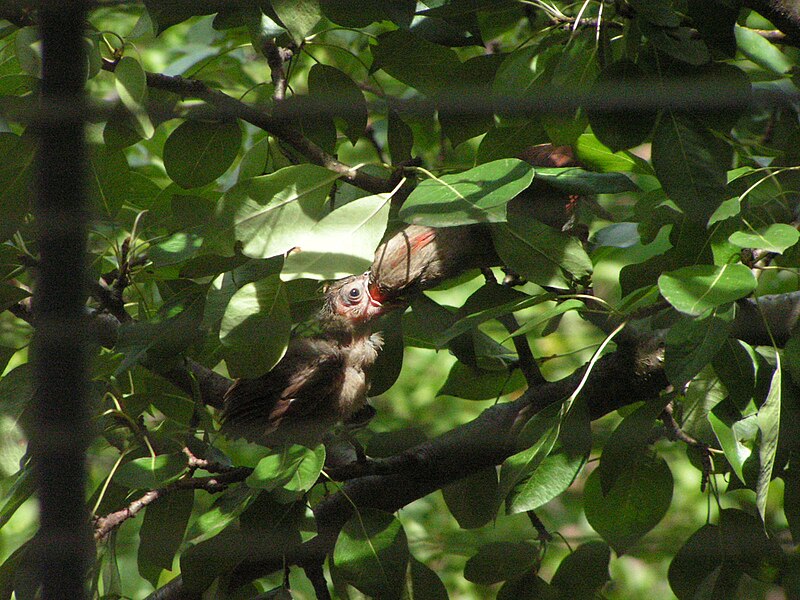
The Northern Cardinal is a mid-sized songbird measuring 21 to 23.5 cm in length with a wingspan of 25 to 31 cm. Males are brilliant crimson red overall with a black face mask surrounding the bill, while females are warm grayish-tan with reddish tinges on the wings, tail, and prominent raised crest. Both sexes possess a distinctive pointed crest atop the head and a stout, bright coral-red to orange conical bill adapted for cracking seeds. Juveniles resemble females but have a darker, grayish-black bill.

Diet

Adults feed primarily on seeds, grains, and fruits, which make up about 90% of the diet. Preferred foods include sunflower seeds, safflower seeds, dogwood berries, wild grape, and various weed seeds. They also consume insects including beetles, cicadas, grasshoppers, and caterpillars, especially during the breeding season. Nestlings are fed almost entirely on insects.

Activity Pattern

Diurnal (Active during day)
Kingdom: Animalia
โ†’
Phylum: Chordata
โ†’
Class: Aves
โ†’
Order: Passeriformes
โ†’
Family: Cardinalidae
โ†’
Genus: Cardinalis
โ†’
Species: C. cardinalis

Scientific Name

Cardinalis cardinalis
Breeding Season
March through September
Nesting Season
March through September; usually raises two broods per year, with the first beginning around March and the second in late May to July. Female lays 1 to 5 eggs (usually 3) with 11 to 13 day incubation.
Migration Pattern
Non-migratory; a permanent year-round resident throughout its range
Lifespan
Average 3 years in the wild, though individuals have been recorded living up to 15 years and 9 months

Behavior

Northern Cardinals are non-migratory and maintain territories year-round. They are most active during morning and evening hours and are often the first bird singing at dawn and last at dusk. Males are strongly territorial during breeding season and may aggressively attack their own reflection in windows and mirrors. They are serially monogamous, with pairs often maintaining their bond through the winter. Males frequently feed females beak-to-beak during courtship. They forage primarily on the ground or in low shrubs, often visiting bird feeders. Their loud, clear whistled song of 'cheer-cheer-cheer' or 'birdy-birdy-birdy' is one of the most recognizable sounds in southeastern backyards.

Ecological Role

Northern Cardinals play a significant role as seed dispersers and insect predators. They consume large quantities of weed seeds, helping control weedy plant populations. During the breeding season, their increased consumption of insects including beetles and caterpillars helps regulate pest populations. They serve as prey for raptors such as Cooper's Hawks and Sharp-shinned Hawks, as well as nest predators like snakes, cats, and Blue Jays. Their widespread abundance makes them an important component of the southeastern food web.

Active Seasons

Spring Summer Fall Winter

Activity Pattern

Diurnal (Active during day)
Habitat Types

Forest
Grassland
Urban

Geographic Distribution

The Northern Cardinal is found across the eastern and central United States, southern Canada, Mexico, and parts of Central America. It is one of the most abundant and recognizable year-round residents of the southeastern US. In the Augusta, GA area and the River Island Conservancy, Northern Cardinals are extremely common in virtually every habitat type including suburban yards, forest edges, thickets, hedgerows, and riparian corridors along the Savannah River. They are among the most frequently observed birds at backyard feeders throughout the region.

Elevation Range

0-5000 ft

Local Abundance

Common

Conservation Status

Least Concern

This species is widespread and abundant. No immediate threat to survival.

Threats & Impacts

Window collisions, predation by domestic and feral cats, nest predation by snakes and Blue Jays, and Brown-headed Cowbird brood parasitism. Habitat loss from urban development affects some populations, though cardinals have adapted well to suburban environments. West Nile virus and other avian diseases pose occasional threats. Overall, the species is increasing in population and expanding its range northward.

How You Can Help

  • Report sightings to contribute to population monitoring
  • Support habitat conservation efforts
  • Follow guidelines when observing wildlife
No field notes or observations available for this species.

Contribute Your Observations

Have you spotted this species? Your observations help us track populations and understand behavior patterns.

Submit an Observation

Gallery