Red-shouldered Hawk

Red-shouldered Hawk

Buteo lineatus

Least Concern

Quick Facts

Kingdom: Animalia
Abundance: Common
Habitat: Forest, Wetland, Wetland
Active Seasons: Spring, Summer, Fall, Winter
Activity: Diurnal (Active during day)
Lifespan: About 2 years average in the wild due to high juvenile mortality; the oldest recorded individual was 19 years, 11 months old

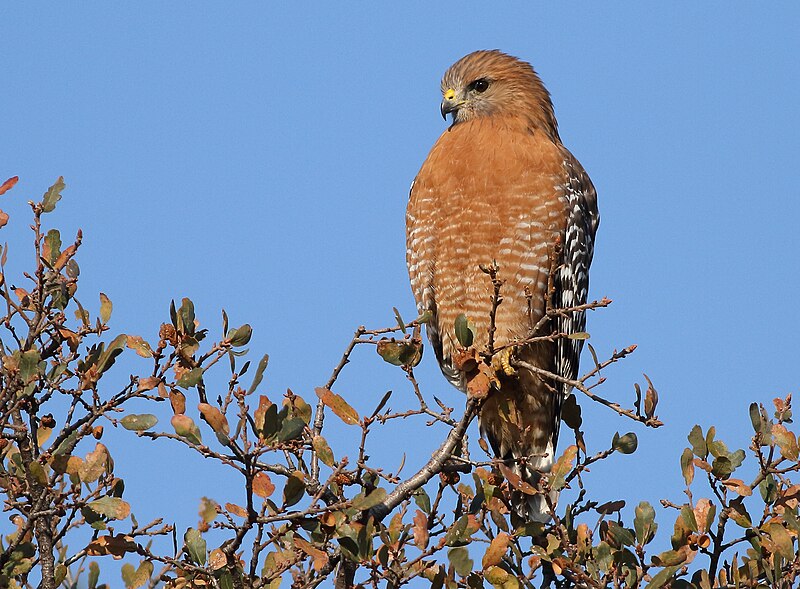
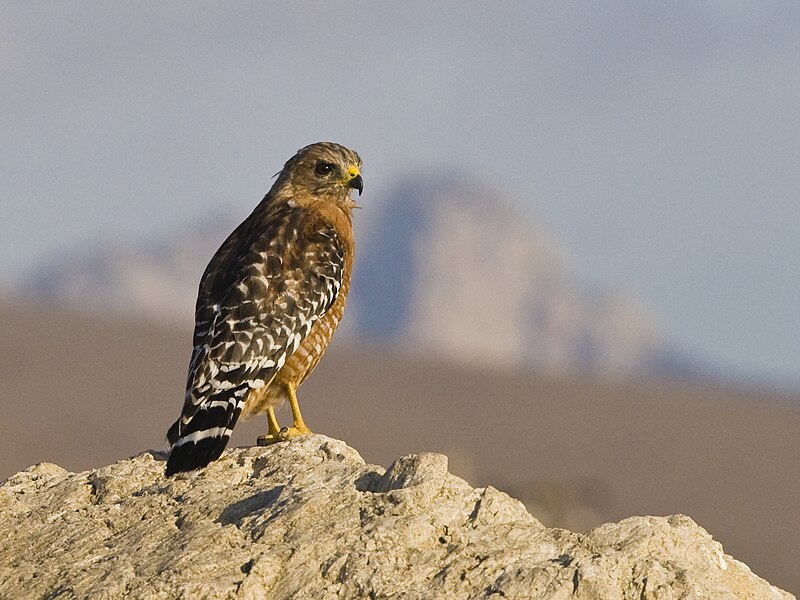
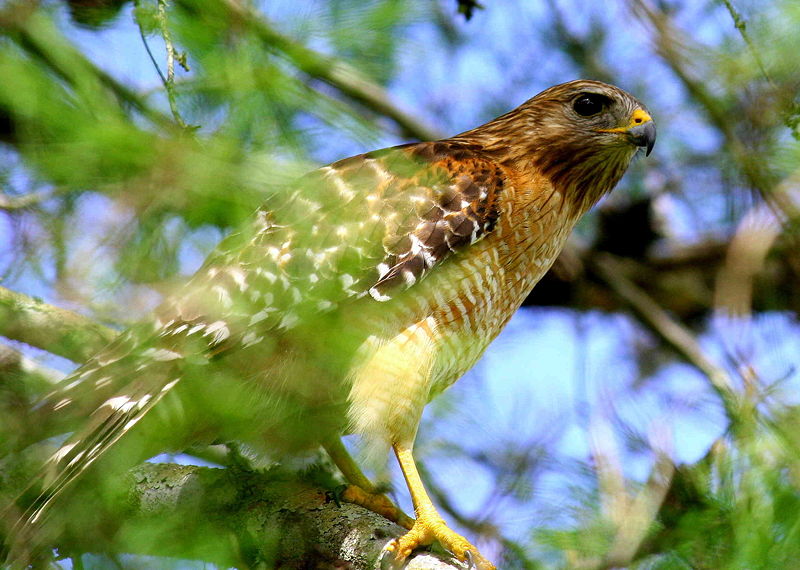
The Red-shouldered Hawk is a medium-sized buteo measuring 15 to 24 inches in length with a wingspan of 35 to 50 inches. Adults have a brownish head, rich reddish-barred chest and belly, and dark brown upperparts with reddish-brown “shoulder” patches visible when perched. The tail is distinctly banded with narrow black and white bars. In flight, translucent crescent-shaped wing panels near the wingtips are a key field mark, and the underwings show a boldly banded black-and-white pattern.

Diet

A generalist predator with a broad diet. Primary prey includes small mammals such as chipmunks, mice, voles, and young rabbits. Amphibians, particularly frogs and toads, and reptiles including snakes and lizards are important food sources, especially in the Southeast. Also takes crayfish, small birds, large insects, and occasionally fish. Hunts from perches 6 to 15 feet above the ground, dropping down on prey spotted in leaf litter or shallow water.

Activity Pattern

Diurnal (Active during day)
Kingdom: Animalia
โ†’
Phylum: Chordata
โ†’
Class: Aves
โ†’
Order: Accipitriformes
โ†’
Family: Accipitridae
โ†’
Genus: Buteo
โ†’
Species: B. lineatus

Scientific Name

Buteo lineatus
Breeding Season
March through July in the southeastern US, with courtship displays beginning in late winter; activity peaks between April and mid-June
Nesting Season
March through July; builds stick nests in the main crotch of large deciduous or mixed-forest trees below the canopy, typically 35 to 65 feet above ground; often reuses nests from previous years; clutch of 3 to 4 eggs incubated for 28 to 33 days
Migration Pattern
Largely non-migratory in the southeastern US; northern populations may migrate south in winter, but southeastern birds including those near Augusta, GA are permanent residents
Lifespan
About 2 years average in the wild due to high juvenile mortality; the oldest recorded individual was 19 years, 11 months old

Behavior

Red-shouldered Hawks are vocal, territorial raptors that hunt from low to medium perches in the forest interior, watching the ground for movement before dropping onto prey. They are monogamous and highly territorial, with pairs defending the same nesting territory year after year. Their loud, repeated "kee-aah" call echoes through the forest and is often the first sign of their presence. Blue Jays are well known for mimicking this call. Courtship involves dramatic aerial displays with soaring, diving, and mutual circling high above the canopy. They often share territories with Barred Owls, hunting by day while the owls hunt at night.

Ecological Role

Red-shouldered Hawks are important mid-level predators in forest ecosystems, helping to control populations of rodents, snakes, frogs, and crayfish. As top predators in the forest understory, they play a key role in maintaining ecological balance in bottomland hardwood and riparian forests. Their presence indicates healthy, mature forest with adequate prey diversity. They compete with and are occasionally displaced by the larger Red-tailed Hawk in areas where forest is fragmented. Their nests provide structure that may be reused by other species such as Great Horned Owls.

Active Seasons

Spring Summer Fall Winter

Activity Pattern

Diurnal (Active during day)
Habitat Types

Forest
Wetland
Wetland

Geographic Distribution

The Red-shouldered Hawk is found throughout the eastern United States from southern Canada to Florida and the Gulf Coast, with a separate population in California and Oregon. It is one of the most common woodland raptors in the Southeast. In the River Island Conservancy area near Augusta, GA, Red-shouldered Hawks are year-round residents in mature bottomland hardwood forests, wooded river corridors, swamp edges, and mixed deciduous-pine forests along the Savannah River. They favor areas where forest and water meet, making the Savannah River floodplain ideal habitat.

Elevation Range

0-5000 ft

Local Abundance

Common

Conservation Status

Least Concern

This species is widespread and abundant. No immediate threat to survival.

Threats & Impacts

Continued clearing and fragmentation of mature forest habitat is the primary threat, as this species requires large tracts of contiguous woodland. Logging of bottomland hardwoods and conversion of forested wetlands reduce available hunting and nesting habitat. Competition with Red-tailed Hawks increases in fragmented landscapes. Secondary poisoning from rodenticides is a growing concern. Collisions with vehicles and windows also contribute to mortality.

How You Can Help

  • Report sightings to contribute to population monitoring
  • Support habitat conservation efforts
  • Follow guidelines when observing wildlife
No field notes or observations available for this species.

Contribute Your Observations

Have you spotted this species? Your observations help us track populations and understand behavior patterns.

Submit an Observation

Gallery