
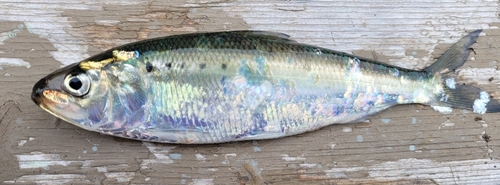
Toothless, schooling, migratory, plankton eaters that live in saltwater and travel up rivers to spawn. The American Shad has a dark, blue-green back, pale sides, silver belly, and weighs 3–8 lbs. The stomach and chest of American shad have sharp scales similar to that of a saw. American shad have one or more black spots in a row on their shoulder. Though rare, some American shad have two rows of black spots. When American shad enter rivers to spawn, their colors darken. Although bony, it has a delicate flavor when cooked. Many esteem its taste to be above the famous Atlantic salmon, without requiring sauces, herbs, or spices. Shad eggs, or “roe,” are a delicacy in the U.S.
American Shad
Alosa sapidissima
Least Concern
Quick Facts
Kingdom:
Animalia
Abundance:
Common
Habitat:
Coastal
Active Seasons:
Spring, Summer, Fall
Activity:
Diurnal (Active during day)
Lifespan:
6-10 years
Overview
Plankton, small shrimp and fish eggs
Diurnal (Active during day)
Classification
Kingdom:
Animalia
→
Phylum:
Chordata
→
Class:
Actinopterygii
→
Order:
Clupeiformes
→
Family:
Alosidae
→
Genus:
Alosa
→
Species:
Alosa sapidissima
Scientific Name
Alosa sapidissima
Characteristics
Breeding Season
Late winter to early spring, usually January in Georgia
Migration Pattern
Migrate to into rivers toward the end of Winter to spawn
Lifespan
6-10 years
Behavior & Ecology
Behavior
American shad are social animals that swim in schools. They do not have a determined home range or defend territory. They are able to detect ultrasonic signals which helps them escape some predators that use ultrasonic signals for communication. Male American shad communicate to females to release their eggs by chasing and nudging the female's belly.
Active Seasons
Spring
Summer
Fall
Activity Pattern
Diurnal (Active during day)
Habitat & Distribution
Habitat Types
Geographic Distribution
American Shad are native to the Atlantic Ocean, ranging from Newfoundland, Nova Scotia and the St. Lawrence River in the north, to areas of coastal central Florida in the south. During spawning season, American shad travel to the rivers of the United States, Canada, and Mexico to lay their eggs. American Shad were introduced to the North Pacific ocean in the 1800s.
Local Abundance
Common
Conservation
Conservation Status
Least Concern
This species is widespread and abundant. No immediate threat to survival.
Threats & Impacts
Pollution and over fishing
How You Can Help
- Report sightings to contribute to population monitoring
- Support habitat conservation efforts
- Follow guidelines when observing wildlife
Field Notes
Additional Notes
Adult American shad darken in color on entering rivers to spawn, which helps them blend into their environment.
Contribute Your Observations
Have you spotted this species? Your observations help us track populations and understand behavior patterns.
Submit an Observation