
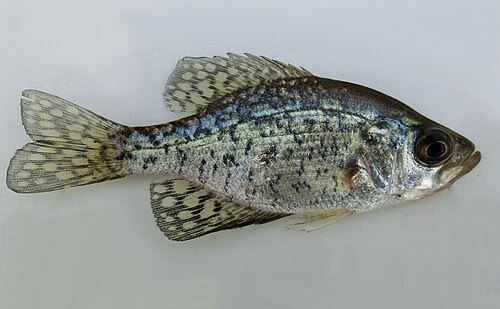
A thin fish with a green back, silver-green sides with dark mottling, silver bellies, a rounded profile, and a long head. The Black Crappie, also known as the Calico Bass, lives in clear lakes, rivers, and streams and is most often darker in color than the similar White Crappie, which generally inhabits silty, slower-moving bodies of water. The Black Crappie has 7 or 8 spines on its dorsal fin, often the only way to differentiate it from the White Crappie. A highly regarded game fish that is most active in the evening, Black Crappie are considered to be one of the best tasting freshwater fish.
Black Crappie
Pomoxis nigromaculatus
Least Concern
Quick Facts
Kingdom:
Animalia
Abundance:
Abundant
Habitat:
Wetland
Active Seasons:
Spring, Summer
Activity:
Nocturnal (Active at night)
Lifespan:
7 years
Overview
Adults eat small fish, crustaceans, and insect larvae while the average juvenile subsists mainly on zooplankton and microcrustaceans.
Nocturnal (Active at night)
Classification
Kingdom:
Animalia
→
Phylum:
Chordata
→
Class:
Actinopterygii
→
Order:
Centrarchiformes
→
Family:
Centrarchidae
→
Genus:
Pomoxis
→
Species:
Pomoxis nigromaculatus
Scientific Name
Pomoxis nigromaculatus
Characteristics
Breeding Season
March-July
Lifespan
7 years
Behavior & Ecology
Behavior
The black crappie is a schooling fish. It moves inland in order to feed and reproduce. It is mostly nocturnal, typically feeding from the hours of midnight to 0200 hours.
Active Seasons
Spring
Summer
Activity Pattern
Nocturnal (Active at night)
Habitat & Distribution
Habitat Types
Geographic Distribution
The Black Crappie is endemic to North America. Its native range encompasses the majority of the eastern United States. The black crappie can be found as far west as the Mississippi River, north to the border between the United States and Canada, and south to the Gulf Coast.
Local Abundance
Abundant
Conservation
Conservation Status
Least Concern
This species is widespread and abundant. No immediate threat to survival.
How You Can Help
- Report sightings to contribute to population monitoring
- Support habitat conservation efforts
- Follow guidelines when observing wildlife
Contribute Your Observations
Have you spotted this species? Your observations help us track populations and understand behavior patterns.
Submit an Observation