
Lifespan:4 to 7 years on average in the wild; the oldest recorded individual was at least 6 years, 1 month old
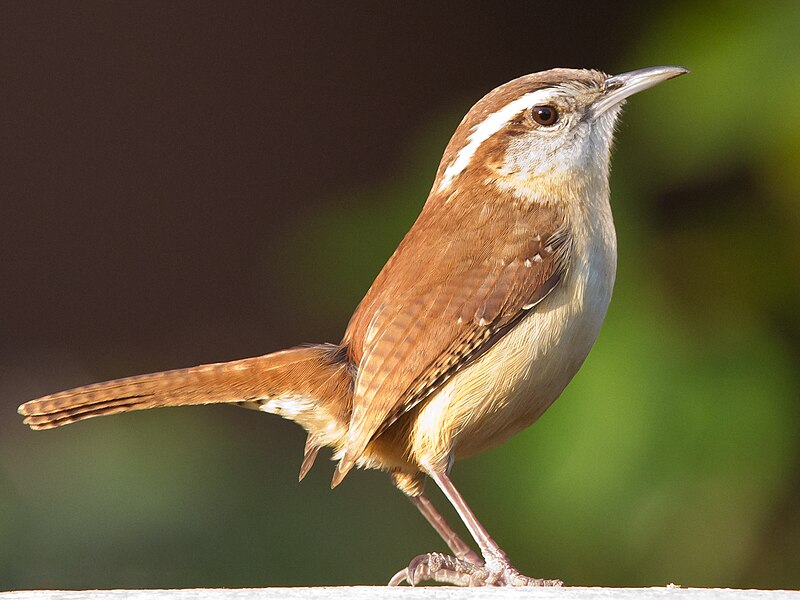
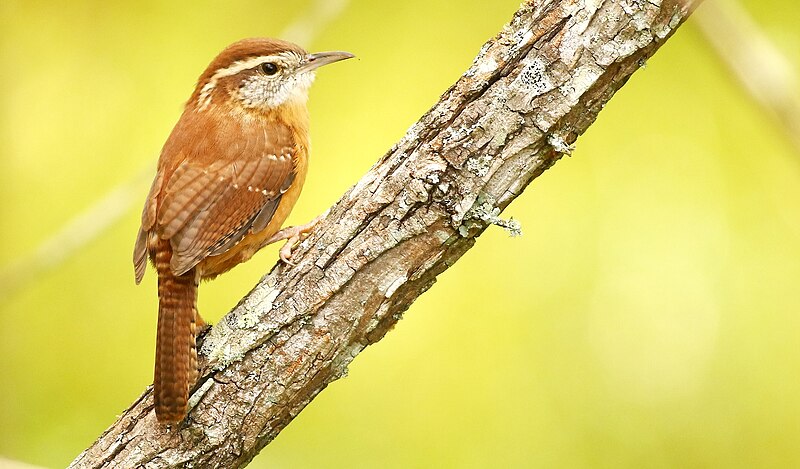
The Carolina Wren is a stocky, round-bodied songbird measuring 12.5 to 14 cm in length with a wingspan of about 29 cm and a weight of 18 to 23 grams, making it the second largest wren in the United States. It has rich rusty-brown upperparts, warm buffy-orange underparts, and bold white eyebrow stripes that extend from the bill to the nape. The wings and tail are barred with black, and the tail is often held cocked upward in the typical wren posture. Its slightly curved bill is proportionally long and well-suited for probing into crevices for insects.
Diet
Insects and spiders make up the bulk of the diet, including beetles, caterpillars, moths, grasshoppers, crickets, cockroaches, and various larvae gleaned from bark, leaf litter, and tangles of vegetation. They forage primarily on or near the ground, probing into bark crevices, overturning leaves, and creeping along branches like a nuthatch. Small amounts of fruit, berries, and seeds are also consumed, especially in winter months. They occasionally take small lizards and tree frogs.
Activity Pattern
Diurnal (Active during day)
Kingdom:Animalia
โ
Phylum:Chordata
โ
Class:Aves
โ
Order:Passeriformes
โ
Family:Troglodytidae
โ
Genus:Thryothorus
โ
Species:T. ludovicianus
Scientific Name
Thryothorus ludovicianus
Breeding Season
March through October
Nesting Season
March through September; nests in natural cavities, brush piles, hanging plants, nest boxes, and even unusual locations such as mailboxes, boots, and flower pots, typically 3 to 6 feet off the ground
Migration Pattern
Non-migratory; a permanent year-round resident with very little seasonal movement
Lifespan
4 to 7 years on average in the wild; the oldest recorded individual was at least 6 years, 1 month old
Behavior
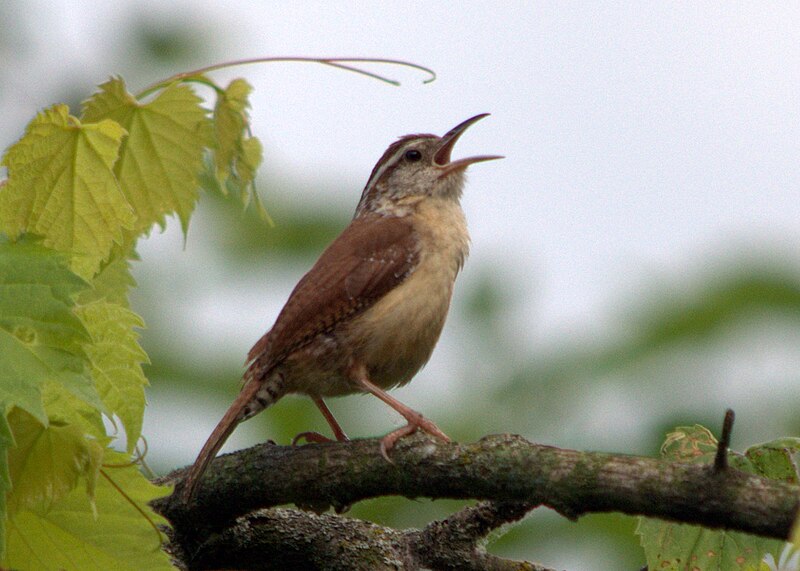
Carolina Wrens are loud, energetic birds that forage actively in dense underbrush and tangles, hopping through leaf litter and probing bark crevices with their curved bills. They are monogamous, with breeding pairs remaining together year-round, often duetting throughout the year with the female giving a chattering accompaniment to the male's ringing song. They build dome-shaped nests with a side entrance in a remarkable variety of locations, from natural cavities to human-made structures. Their explosive, rolling song of repeated "teakettle-teakettle-teakettle" phrases can be heard in any season and is disproportionately loud for such a small bird.
Ecological Role
Carolina Wrens are important predators of insects and spiders, helping to control populations of beetles, caterpillars, and other invertebrates in forest understory and leaf litter. Their foraging behavior helps cycle nutrients by turning over leaf litter. As cavity nesters, they use and modify a wide variety of nesting sites, contributing to the ecological dynamics of cavity-nesting bird communities. They serve as prey for small hawks, owls, snakes, and domestic cats.
Active Seasons
Spring
Summer
Fall
Winter
Activity Pattern
Diurnal (Active during day)
Habitat Types
Forest
Urban
Wetland
Geographic Distribution
The Carolina Wren is found throughout the southeastern United States, from southern New England and the Great Lakes region south to Florida and the Gulf Coast, and west to eastern Texas and Oklahoma. It is one of the most common and vocal resident birds throughout Georgia and South Carolina. In the River Island Conservancy area near Augusta, GA, Carolina Wrens are abundant year-round residents in deciduous forests, brushy thickets, wooded swamps, suburban gardens, and any area with dense shrubby cover along the Savannah River corridor. Populations can suffer significant declines during harsh winters but typically recover within a few years.
Elevation Range
0-4500 ft
Local Abundance
Common
Conservation Status
Least Concern
This species is widespread and abundant. No immediate threat to survival.
Threats & Impacts
Severe winter weather with ice storms and prolonged cold can cause dramatic population declines, as this species is particularly vulnerable to cold due to its insectivorous diet and small body size. Additional threats include habitat loss from clearing of brushy undergrowth, predation by house cats and snakes, Brown-headed Cowbird nest parasitism, and competition for nest sites with House Wrens and House Sparrows.
How You Can Help
Report sightings to contribute to population monitoring
Support habitat conservation efforts
Follow guidelines when observing wildlife
No field notes or observations available for this species.
Contribute Your Observations
Have you spotted this species? Your observations help us track populations and understand behavior patterns.