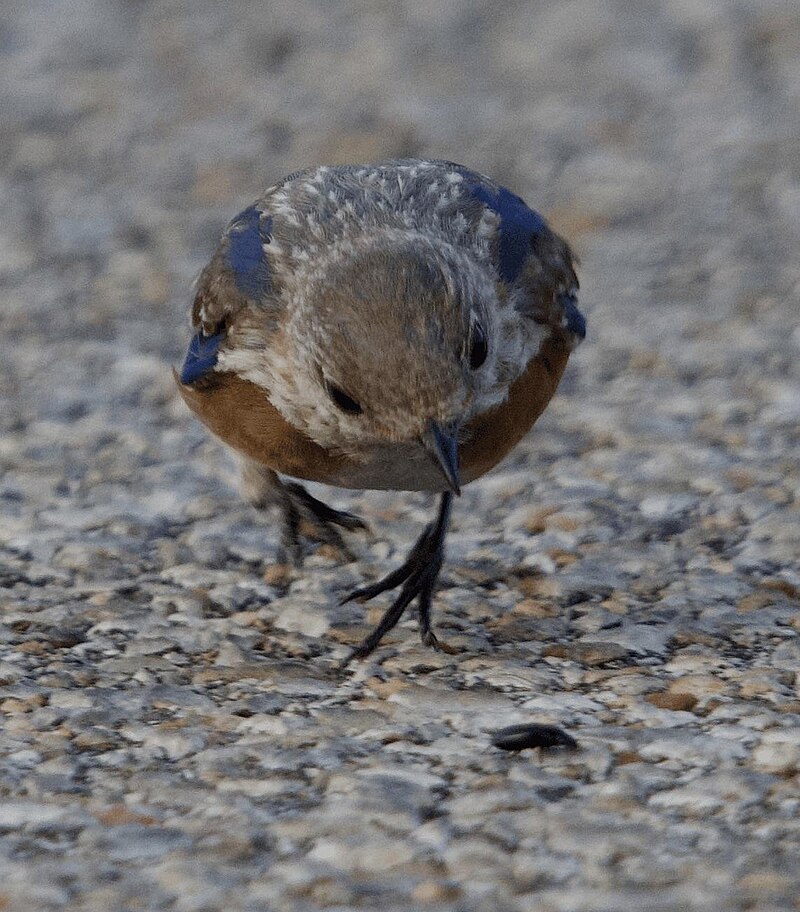
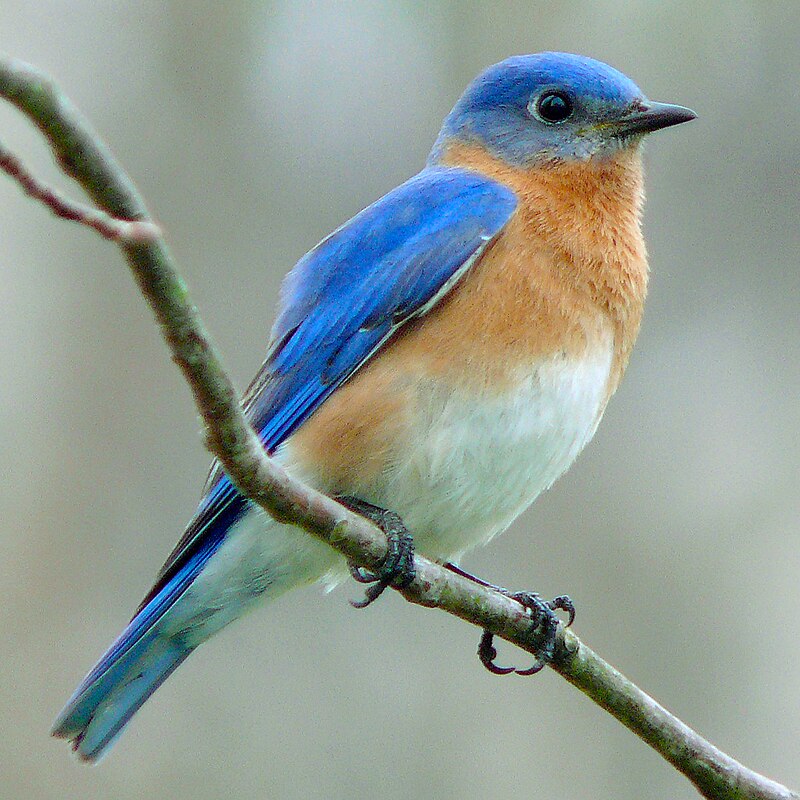
The Eastern Bluebird is a small thrush measuring 6.3 to 8.3 in (16 to 21 cm) in length with a wingspan of 9.8 to 13 in (25 to 32 cm). Males display brilliant royal blue upperparts with a warm rusty-red breast and white belly, while females are more subdued grayish-blue with a softer orange-brown breast. Both sexes have a slender, straight black bill adapted for catching insects, and dark gray to blackish legs. Juveniles are grayish with spotted breasts and blue-tinged wings and tail.
Eastern Bluebird
Sialia sialis
Least Concern
Quick Facts
Kingdom:
Animalia
Abundance:
Common
Habitat:
Forest, Grassland, Urban
Active Seasons:
Spring, Summer, Fall, Winter
Activity:
Diurnal (Active during day)
Lifespan:
6 to 10 years in the wild; the oldest recorded individual lived 10 years and 5 months
Elevation:
0-5000 ft
Overview
Approximately 68% insects including grasshoppers, crickets, beetles, caterpillars, and spiders, typically spotted from a perch and caught on the ground. The remaining diet consists of fruit and berries including flowering dogwood, holly, mulberry, wild grape, Virginia creeper, pokeweed, and viburnum.
Diurnal (Active during day)
Classification
Kingdom:
Animalia
→
Phylum:
Chordata
→
Class:
Aves
→
Order:
Passeriformes
→
Family:
Turdidae
→
Genus:
Sialia
→
Species:
Sialia sialis
Scientific Name
Sialia sialis
Characteristics
Breeding Season
March through August
Nesting Season
March through August, typically raising two broods per year
Migration Pattern
Partial migrant; northern populations move south in winter, while southeastern populations are largely year-round residents
Lifespan
6 to 10 years in the wild; the oldest recorded individual lived 10 years and 5 months
Behavior & Ecology
Behavior
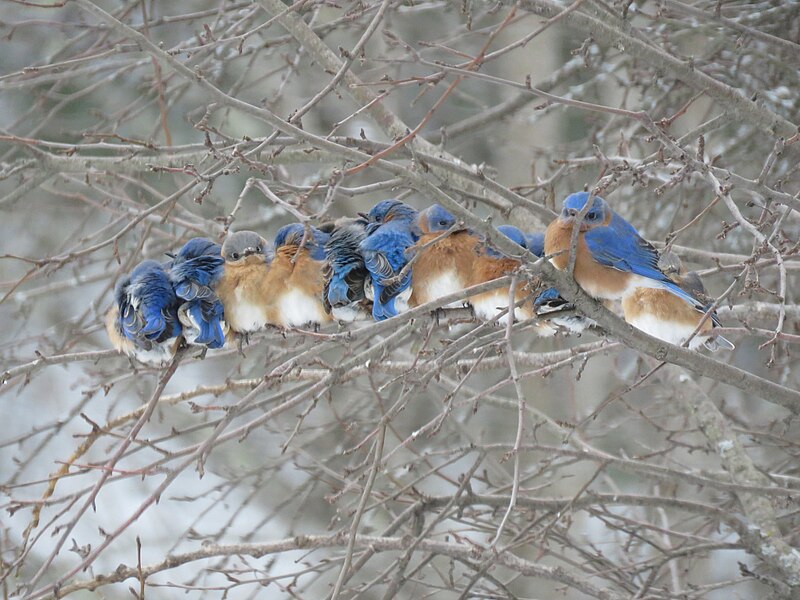
Eastern Bluebirds are generally monogamous cavity nesters that prefer abandoned woodpecker holes and nest boxes. Females construct cup-shaped nests lined with soft grass over about 10 days and lay 3 to 7 pale blue eggs per clutch. They are perch-and-pounce hunters, sitting on low branches or fence posts and dropping to the ground to catch insects. In winter, they form mixed-species flocks and forage in hedgerows and woodland edges. They are territorial during breeding season but become more social in the non-breeding months.
Ecological Role
Eastern Bluebirds serve as important insect population regulators, consuming large quantities of grasshoppers, beetles, and caterpillars that can be agricultural pests. They also play a role in seed dispersal by consuming wild fruits and berries. As cavity nesters, they are part of the ecological succession of tree cavity use, often depending on woodpecker-created holes.
Active Seasons
Spring
Summer
Fall
Winter
Activity Pattern
Diurnal (Active during day)
Habitat & Distribution
Habitat Types
Geographic Distribution
The Eastern Bluebird is found throughout the eastern United States and southeastern Canada, extending south into Central America. In the southeastern U.S., it is a common year-round resident across Georgia, South Carolina, and the broader Piedmont and Coastal Plain regions.
Elevation Range
0-5000 ft
Local Abundance
Common
Conservation
Conservation Status
Least Concern
This species is widespread and abundant. No immediate threat to survival.
Threats & Impacts
Habitat loss due to removal of dead trees and fence rows, competition for nesting cavities from European Starlings and House Sparrows, pesticide use reducing insect prey, and severe winter weather events. Nest box programs have successfully mitigated many of these threats since the 1960s and 1970s.
How You Can Help
- Report sightings to contribute to population monitoring
- Support habitat conservation efforts
- Follow guidelines when observing wildlife
Contribute Your Observations
Have you spotted this species? Your observations help us track populations and understand behavior patterns.
Submit an Observation