
Northern Flicker

Northern Flicker

Colaptes auratus

Least Concern

Quick Facts

Kingdom: Animalia
Abundance: Common
Habitat: Forest, Grassland, Urban
Active Seasons: Spring, Summer, Fall, Winter
Activity: Diurnal (Active during day)
Lifespan: 5 to 7 years on average in the wild; the oldest recorded individual was at least 9 years, 2 months old

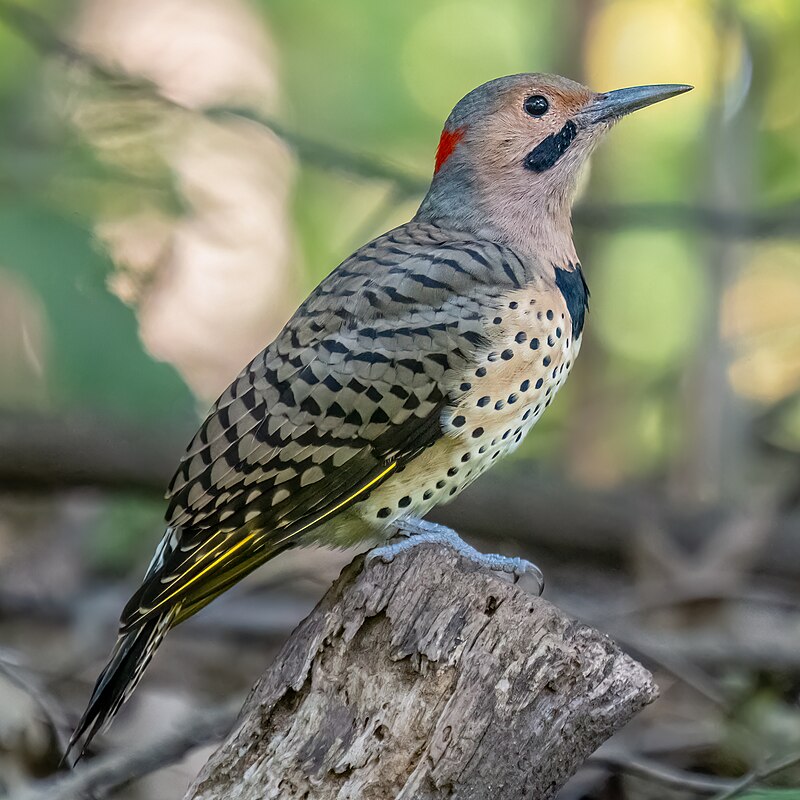
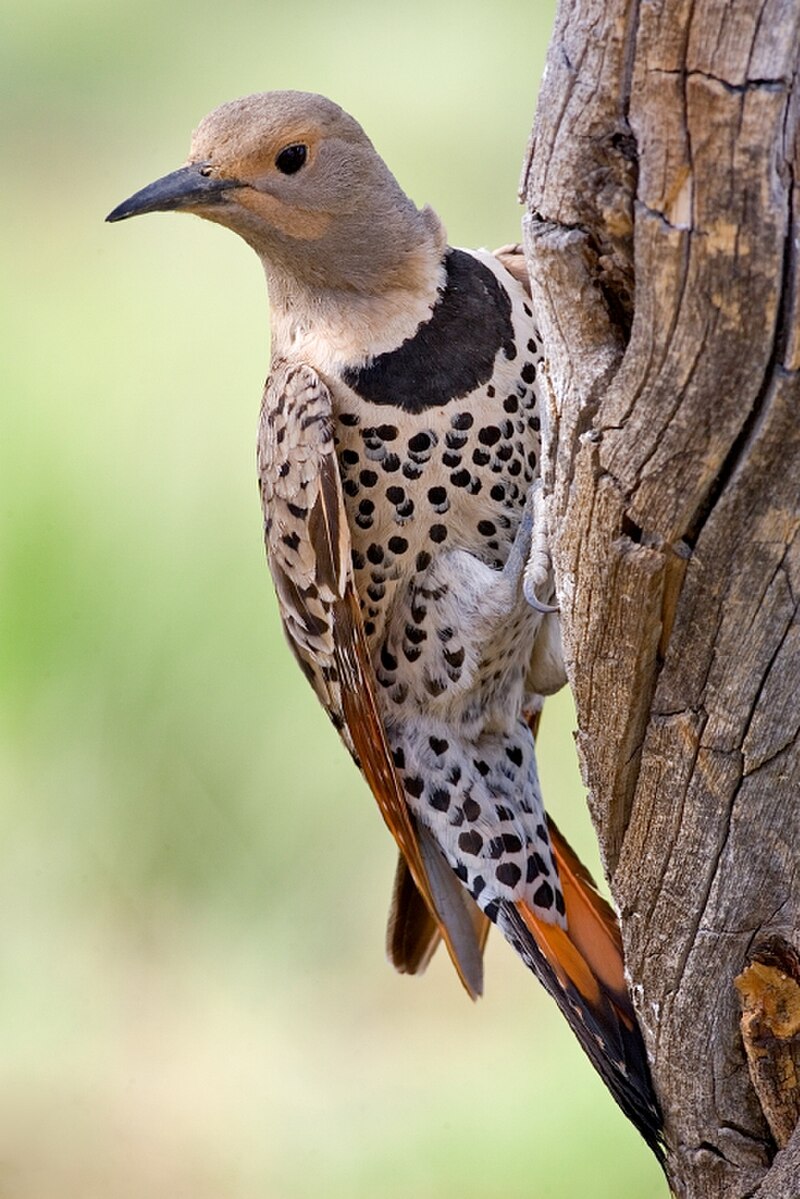
The Northern Flicker is a large, distinctive woodpecker measuring 28 to 36 cm in length with a wingspan of 42 to 54 cm and a weight of 86 to 167 grams. It has a brown body barred with black on the back and wings, a black crescent-shaped bib on the upper breast, and a boldly spotted white belly. The eastern Yellow-shafted subspecies displays bright golden-yellow underwings and tail shafts, a gray crown, a tan face with a red crescent on the nape, and males have a black moustachial stripe. In flight, the bright yellow under the wings and tail and the prominent white rump patch are unmistakable.

Diet

Ants and beetles form the primary diet, with ants alone comprising up to 45% of the total food intake. Northern Flickers forage primarily on the ground, probing soil and anthills with their remarkably long, barbed tongue that can extend up to 4 cm beyond the bill tip to lap up ants and larvae. They also eat other insects, including beetles, termites, caterpillars, and crickets. In fall and winter, fruits and berries become an important supplement, including dogwood berries, sumac, poison ivy berries, hackberries, and wild grapes.

Activity Pattern

Diurnal (Active during day)
Kingdom: Animalia
โ†’
Phylum: Chordata
โ†’
Class: Aves
โ†’
Order: Piciformes
โ†’
Family: Picidae
โ†’
Genus: Colaptes
โ†’
Species: C. auratus

Scientific Name

Colaptes auratus
Breeding Season
February through July
Nesting Season
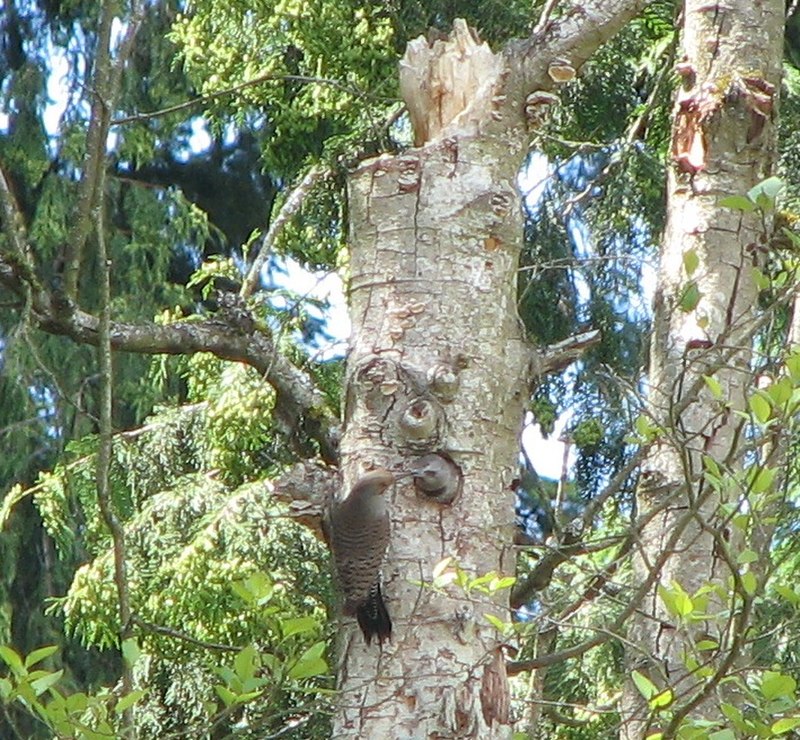
April through June; excavates nest cavities in dead or dying trees, typically 6 to 15 feet above ground, though occasionally higher; both sexes participate in excavation, which takes about 12 to 16 days
Migration Pattern
Partial migrant; northern populations migrate south for winter, while southeastern populations are largely year-round residents
Lifespan
5 to 7 years on average in the wild; the oldest recorded individual was at least 9 years, 2 months old

Behavior

Northern Flickers are unusual among woodpeckers in that they spend much of their time foraging on the ground, probing for ants in soil and lawns. Their flight is distinctive, consisting of an undulating pattern of several flaps followed by a glide, flashing the bright yellow underwings. They excavate nest cavities in dead or diseased trees, and both parents share incubation and chick-rearing duties. Their loud "wicka-wicka-wicka" call and drumming on resonant surfaces are characteristic sounds of spring. Males perform dramatic "fencing" territorial displays where rival males face each other and bob their heads rhythmically.

Ecological Role

Northern Flickers are keystone cavity excavators, creating nest holes in dead trees that are subsequently used by a wide variety of secondary cavity-nesting birds, mammals, and insects, including Eastern Bluebirds, screech-owls, flying squirrels, and native bees. They are among the most important ant predators in North American forests and grasslands, helping to regulate ant populations. Their ground-foraging behavior aerates soil. They serve as prey for Cooper's Hawks, Sharp-shinned Hawks, and other raptors, and compete with European Starlings for nesting cavities.

Active Seasons

Spring Summer Fall Winter

Activity Pattern

Diurnal (Active during day)
Habitat Types

Forest
Grassland
Urban

Geographic Distribution

The Northern Flicker is native to most of North America, from Alaska and Canada south through the United States to Mexico and Central America. The Yellow-shafted subspecies is the form found throughout the eastern United States. In the River Island Conservancy area near Augusta, GA, Northern Flickers are common year-round residents found in open woodlands, forest edges, suburban yards, parks, and fields with scattered trees throughout the Piedmont region and along the Savannah River corridor. Winter numbers are augmented by migrants from northern populations.

Elevation Range

0-5000 ft

Local Abundance

Common

Conservation Status

Least Concern

This species is widespread and abundant. No immediate threat to survival.

Threats & Impacts

Competition with European Starlings for freshly excavated nesting cavities is the most significant threat, as starlings frequently evict flickers from their nest holes. Populations have declined by an estimated 49% between 1966 and 2021, likely due to loss of dead trees and snags from land management practices, pesticide use reducing ant and beetle prey, and habitat loss from development. Collisions with windows and vehicles are also a concern.

How You Can Help

  • Report sightings to contribute to population monitoring
  • Support habitat conservation efforts
  • Follow guidelines when observing wildlife
No field notes or observations available for this species.

Contribute Your Observations

Have you spotted this species? Your observations help us track populations and understand behavior patterns.

Submit an Observation

Gallery