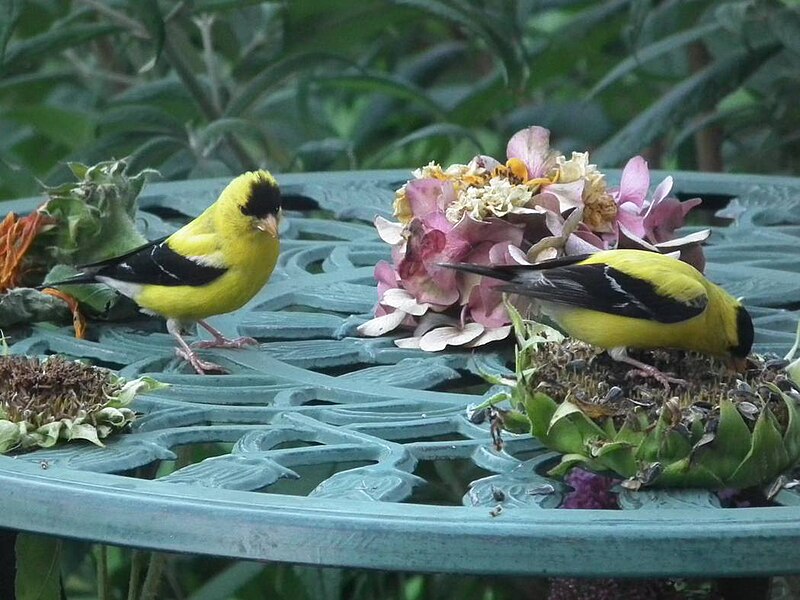
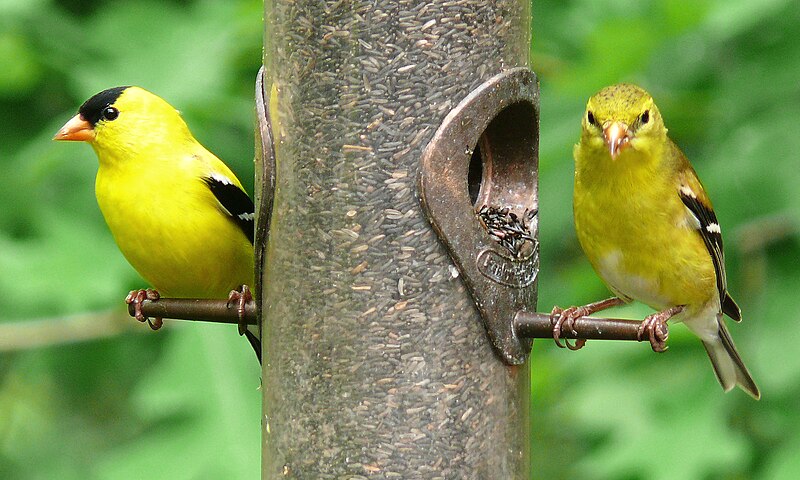
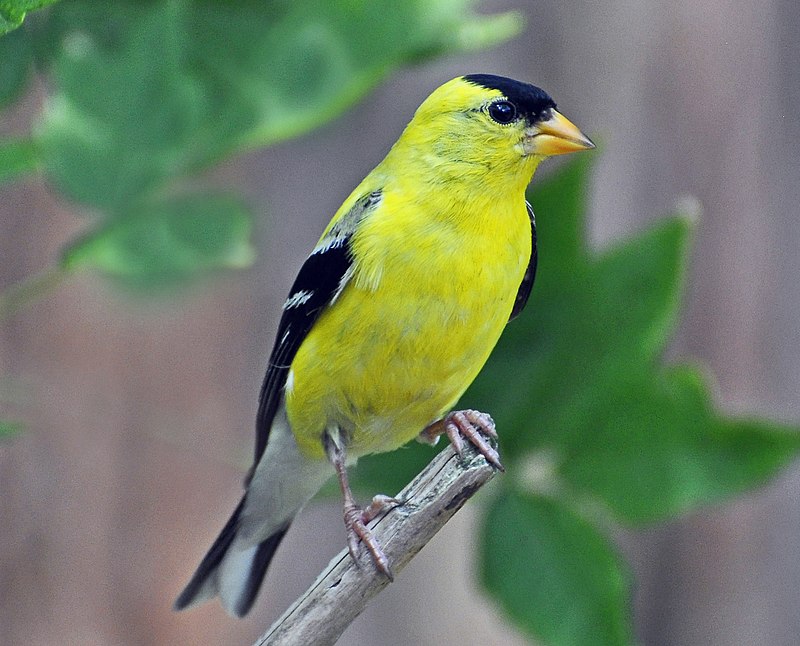
The American Goldfinch is a small finch measuring 4.3 to 5.1 in (11 to 13 cm) in length with a wingspan of 7.9 to 8.7 in (20 to 22 cm) and a weight of 0.4 to 0.7 oz (11 to 20 g). Breeding males are a striking brilliant lemon-yellow with a jet-black cap, black wings with white wing bars, and a white rump visible in flight. Females and non-breeding males are a subdued olive-brown with darker wings and faint wing bars. The species has a conical, pinkish bill adapted for extracting seeds from seed heads, and it undergoes two complete molts per year, making it the only cardueline finch with this trait.
American Goldfinch
Spinus tristis
Least Concern
Quick Facts
Kingdom:
Animalia
Abundance:
Common
Habitat:
Grassland, Forest, Urban
Active Seasons:
Spring, Summer, Fall, Winter
Activity:
Diurnal (Active during day)
Lifespan:
3 to 6 years on average in the wild; the oldest recorded individual was 10 years and 9 months old
Elevation:
0-5000 ft
Overview
Among the strictest vegetarians in the bird world, feeding almost exclusively on seeds. Preferred food sources include seeds from composite plants such as thistles, dandelions, sunflowers, and coneflowers, along with seeds from grasses, birch, alder, and elm. They occasionally consume small insects inadvertently while feeding on seed heads. At feeders, they strongly prefer nyjer (thistle) seed and sunflower chips.
Diurnal (Active during day)
Classification
Kingdom:
Animalia
→
Phylum:
Chordata
→
Class:
Aves
→
Order:
Passeriformes
→
Family:
Fringillidae
→
Genus:
Spinus
→
Species:
Spinus tristis
Scientific Name
Spinus tristis
Characteristics
Breeding Season
Late June through September
Nesting Season
July through September; one of the latest-nesting songbirds in North America, timing nesting to coincide with the availability of thistle and milkweed down for nest construction and seed crops for feeding young
Migration Pattern
Short-distance migrant; northern populations move south in winter while southeastern populations may be year-round residents or shift slightly southward depending on food availability
Lifespan
3 to 6 years on average in the wild; the oldest recorded individual was 10 years and 9 months old
Behavior & Ecology
Behavior
American Goldfinches are highly gregarious and form large flocks during the non-breeding season, often feeding together at seed heads and feeders. Their flight is distinctively undulating with a bouncy, roller-coaster pattern accompanied by a "po-ta-to-chip" flight call. They are among the latest-nesting songbirds, waiting until midsummer when thistle and milkweed produce the fibrous down used to build their compact, cup-shaped nests. The female builds the nest and incubates 4 to 6 pale blue eggs for 12 to 14 days. Males feed the female during incubation and help feed nestlings. Their bright plumage is produced by carotenoid pigments from their plant-based diet.
Ecological Role
American Goldfinches are important seed predators and dispersers that help regulate weed and wildflower populations. Their late nesting season means they serve as food sources for predators during a period when other songbird nests have fledged. They are also hosts for Brown-headed Cowbird eggs, though cowbird chicks rarely survive in goldfinch nests because the all-seed diet fails to provide enough protein for cowbird nestling development.
Active Seasons
Spring
Summer
Fall
Winter
Activity Pattern
Diurnal (Active during day)
Habitat & Distribution
Habitat Types
Geographic Distribution
The American Goldfinch breeds across southern Canada and the northern two-thirds of the United States, wintering from southern Canada through the southern United States into northern Mexico. In the southeastern U.S., it is found year-round across most of Georgia, South Carolina, and the broader Piedmont region. They are frequently seen along roadsides and field edges where thistles, sunflowers, and other seed-bearing plants grow.
Elevation Range
0-5000 ft
Local Abundance
Common
Conservation
Conservation Status
Least Concern
This species is widespread and abundant. No immediate threat to survival.
Threats & Impacts
Slight population declines have been observed over recent decades, likely due to habitat loss from development and agricultural intensification that removes weedy field edges and hedgerows. Pesticide and herbicide use reduces both food sources and nesting material plants like thistles and milkweed. Window collisions and outdoor cats also contribute to mortality.
How You Can Help
- Report sightings to contribute to population monitoring
- Support habitat conservation efforts
- Follow guidelines when observing wildlife
Contribute Your Observations
Have you spotted this species? Your observations help us track populations and understand behavior patterns.
Submit an Observation