
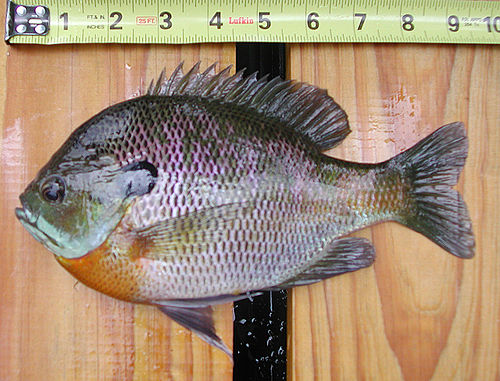
Usually olive-colored with a purple luster, greenish stripes, and a large black spot at the rear of the dorsal fin. The sides of its head and chin are commonly a dark shade of blue, hence the name “bluegill”. Bluegills are most commonly found in lily ponds and around docks and boat landings. A favorite of both fly and bobber fishermen, the freshwater Bluegill is the most popular freshwater sport fish in the U.S. and is known as a tasty pan fish (just the right size for frying whole in the pan). State regulations apply, but “keeping size” is generally the span of your hand or larger.
Bluegill
Lepomis macrochirus
Least Concern
Quick Facts
Kingdom:
Animalia
Abundance:
Abundant
Habitat:
Wetland
Active Seasons:
Spring, Summer
Activity:
Crepuscular (Active at dawn/dusk)
Lifespan:
4-6 years
Overview
Bluegills are carnivores, primarily eating invertebrates such as snails, worms, shrimp, aquatic insects, small crayfish, and zooplankton.
Crepuscular (Active at dawn/dusk)
Classification
Kingdom:
Animalia
→
Phylum:
Chordata
→
Class:
Actinopterygii
→
Order:
Centrarchiformes
→
Family:
Centrarchidae
→
Genus:
Lepomis
→
Species:
Lepomis macrochirus
Scientific Name
Lepomis macrochirus
Characteristics
Breeding Season
May-August
Lifespan
4-6 years
Behavior & Ecology
Behavior
Bluegill are most active at dawn. During the day they stay hidden under cover, and they move to shallow water to spend the night. Bluegill are social and schools may contain 10 to 20 fish.
Ecological Role
Bluegills play an important role in pond and lake management to keep crustacean and insect populations low, as a single bluegill population may eat up to six times its own weight in just one summer.
Active Seasons
Spring
Summer
Activity Pattern
Crepuscular (Active at dawn/dusk)
Habitat & Distribution
Habitat Types
Geographic Distribution
The bluegill occurs naturally in the United States east of the Rocky Mountains from coastal Virginia to Florida, west to Texas and northern Mexico, and north to western Minnesota, New York and southeastern Ontario.
Local Abundance
Abundant
Conservation
Conservation Status
Least Concern
This species is widespread and abundant. No immediate threat to survival.
How You Can Help
- Report sightings to contribute to population monitoring
- Support habitat conservation efforts
- Follow guidelines when observing wildlife
Contribute Your Observations
Have you spotted this species? Your observations help us track populations and understand behavior patterns.
Submit an Observation