
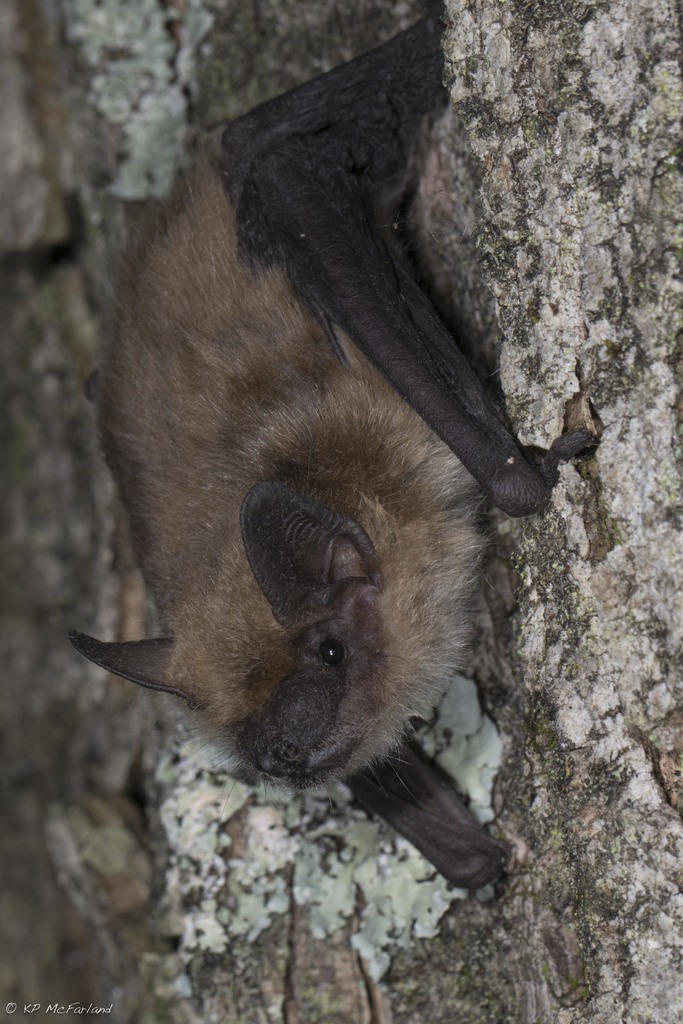
A common, widespread, medium-sized bat with long, chestnut brown fur and hairless black ears, face, wings, and tail. It forages at night over wooded areas, rivers, farmlands, and cities and rests during the day under loose tree bark, in tree hollows, rock crevices, buildings, or caves. The Big Brown Bat feeds on insects and will bite if handled.
Big Brown Bat
Eptesicus fuscus
Least Concern
Quick Facts
Kingdom:
Animalia
Abundance:
Common
Habitat:
Forest, Urban
Active Seasons:
Spring, Summer, Fall
Activity:
Nocturnal (Active at night)
Lifespan:
up to 19 years
Overview
Insects
Nocturnal (Active at night)
Classification
Kingdom:
Animalia
→
Phylum:
Chordata
→
Class:
Mammalia
→
Order:
Chiroptera
→
Family:
Vespertilionidae
→
Genus:
Eptesicus
→
Species:
Eptesicus fuscus
Scientific Name
Eptesicus fuscus
Characteristics
Breeding Season
Fall
Lifespan
up to 19 years
Behavior & Ecology
Behavior
The big brown bat is nocturnal, roosting in sheltered places during the day. It will utilize a wide variety of structures for roosts, including mines, caves, tunnels, buildings, bat boxes, tree cavities, storm drains, wood piles, and rock crevices. They generally roost in cavities, though they can sometimes be found under exfoliating bark. Female big brown bats form maternity colonies to rear young. The size of these colonies can vary from 5 to 700 animals. Males of the species roost alone or in small groups during this time. Both sexes will roost together again in the late summer. Big brown bats enter into hibernation around November, often in a location less than 80 km (50 mi) away from their summer roosts.
Active Seasons
Spring
Summer
Fall
Activity Pattern
Nocturnal (Active at night)
Habitat & Distribution
Habitat Types
Geographic Distribution
Distributed widely throughout North America, the Caribbean, and the northern portion of South America.
Local Abundance
Common
Conservation
Conservation Status
Least Concern
This species is widespread and abundant. No immediate threat to survival.
How You Can Help
- Report sightings to contribute to population monitoring
- Support habitat conservation efforts
- Follow guidelines when observing wildlife
Contribute Your Observations
Have you spotted this species? Your observations help us track populations and understand behavior patterns.
Submit an ObservationAudio Call
This recording may not play in your browser. Download the recording