
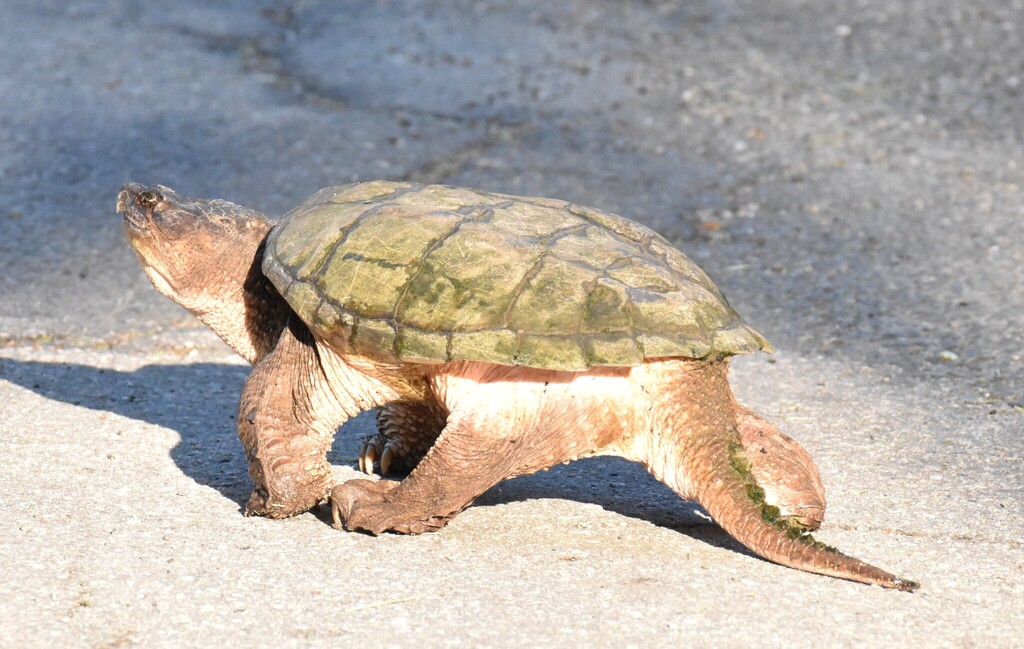
A large freshwater turtle known for its combative disposition when out of the water with its powerful beak-like jaws, and highly mobile head and neck. The shell ranges in color from dark brown to tan and can even be black in some individuals. Snapping turtles have characteristic tubercles (protrusions) on their necks and legs. Plastrons (bottom of the shell) of snapping turtles are very small and leave much of the extremities exposed. Snapping turtle necks, legs, and tails have a yellowish color and the head is dark in color.
Common Snapping Turtle
Chelydra serpentina
Least Concern
Quick Facts
Kingdom:
Animalia
Abundance:
Common
Habitat:
Wetland
Activity:
Diurnal (Active during day)
Lifespan:
Estimated up to 30 years
Overview
Snapping turtles are omnivores and opportunistic feeders. They feed on carrion, invertebrates, fish, birds, small mammals, amphibians, and a surprisingly large amount of aquatic vegetation.
Diurnal (Active during day)
Classification
Kingdom:
Animalia
→
Phylum:
Chordata
→
Class:
Reptilia
→
Order:
Testudines
→
Family:
Chelydridae
→
Genus:
Chelydra
→
Species:
Chelydra serpentina
Scientific Name
Chelydra serpentina
Characteristics
Breeding Season
April-November
Lifespan
Estimated up to 30 years
Behavior & Ecology
Behavior
Snapping turtles are not social creatures. Social interactions are limited to aggressive interactions between individuals, usually males. Many individuals can be found within a small range; snapping turtle density is normally related to the amount of available food. Snapping turtles can be very vicious when removed from the water, but they become docile when placed back into the water. Snapping turtles sometimes bury themselves in mud with only their nostrils and eyes exposed. This burying behavior is used as a means of ambushing prey.
Activity Pattern
Diurnal (Active during day)
Habitat & Distribution
Habitat Types
Geographic Distribution
Its natural range extends from southeastern Canada, southwest to the edge of the Rocky Mountains, as far east as Nova Scotia and Florida.
Local Abundance
Common
Conservation
Conservation Status
Least Concern
This species is widespread and abundant. No immediate threat to survival.
How You Can Help
- Report sightings to contribute to population monitoring
- Support habitat conservation efforts
- Follow guidelines when observing wildlife
Contribute Your Observations
Have you spotted this species? Your observations help us track populations and understand behavior patterns.
Submit an Observation