
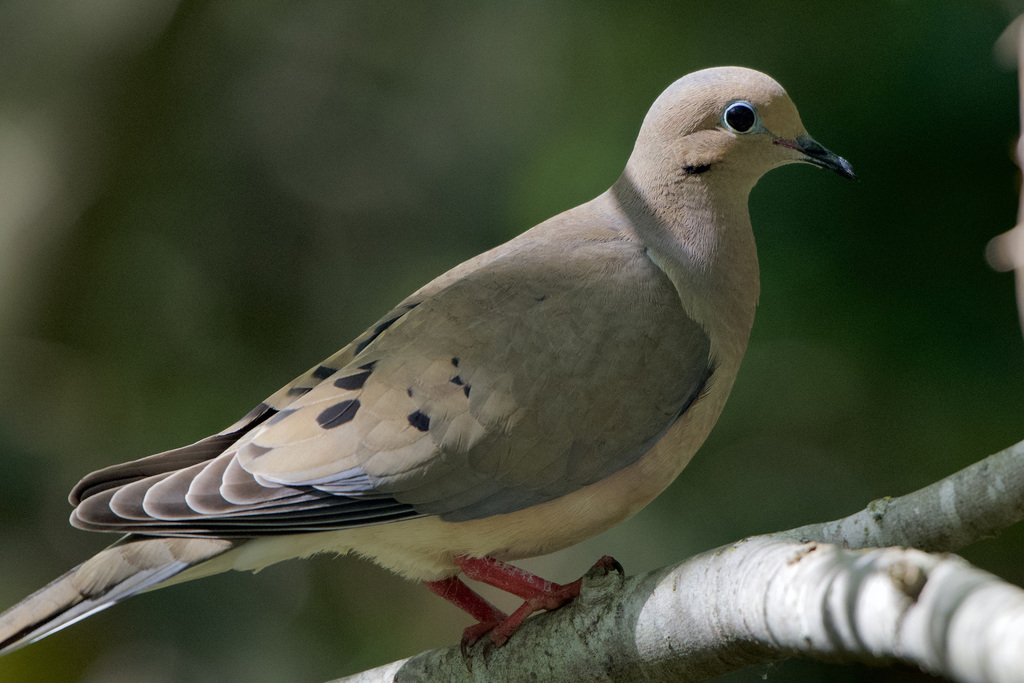
A soft, buff-colored bird with a small head, spots on its wings, and a long pointed tail bordered with white. This tame bird forages on the ground eating grains, seeds, and insects and readily makes itself at home close to humans. Mourning Doves can be found in every state in the U.S.
Mourning Dove
Zenaida macroura
Least Concern
Quick Facts
Kingdom:
Animalia
Abundance:
Abundant
Habitat:
Forest, Grassland, Wetland, Urban
Activity:
Diurnal (Active during day)
Lifespan:
1.5 years on average
Overview
Feeds almost entirely on seeds
Diurnal (Active during day)
Classification
Kingdom:
Animalia
→
Phylum:
Chordata
→
Class:
Aves
→
Order:
Columbiformes
→
Family:
Columbidae
→
Genus:
Zenaida
→
Species:
Zenaida macroura
Scientific Name
Zenaida macroura
Characteristics
Breeding Season
February-October
Migration Pattern
Those that spend the summer further south are more sedentary, with much shorter migrations. At the southern part of their range, Mourning Doves are present year-round. Fall migration in the South runs from September to November, with immatures moving first, followed by adult females and then by adult males.
Lifespan
1.5 years on average
Behavior & Ecology
Behavior
Mourning doves sunbathe or rain bathe by lying on the ground or a flat tree limb, leaning over, stretching one wing, and keeping this posture for up to twenty minutes. These birds can also water bathe in shallow pools or birdbaths. Dustbathing is common as well. Mourning Doves feed on the ground and in the open. They peck or push aside ground litter, but don’t scratch at the ground. Mourning doves are monogamous, some pairs stay together through the winter. Their wings whistle when they fly away and their call is a distinctive cooing sound.
Activity Pattern
Diurnal (Active during day)
Habitat & Distribution
Habitat Types
Geographic Distribution
Mourning doves are only native to the Nearctic region. They live from southern Canada, throughout the United States, and south to Panama. Mourning doves are found year-round throughout most of their range but northern populations migrate south during the winter.
Local Abundance
Abundant
Conservation
Conservation Status
Least Concern
This species is widespread and abundant. No immediate threat to survival.
How You Can Help
- Report sightings to contribute to population monitoring
- Support habitat conservation efforts
- Follow guidelines when observing wildlife
Contribute Your Observations
Have you spotted this species? Your observations help us track populations and understand behavior patterns.
Submit an ObservationLearn more
More about this species on All About Birds ↗ (opens in a new tab)